
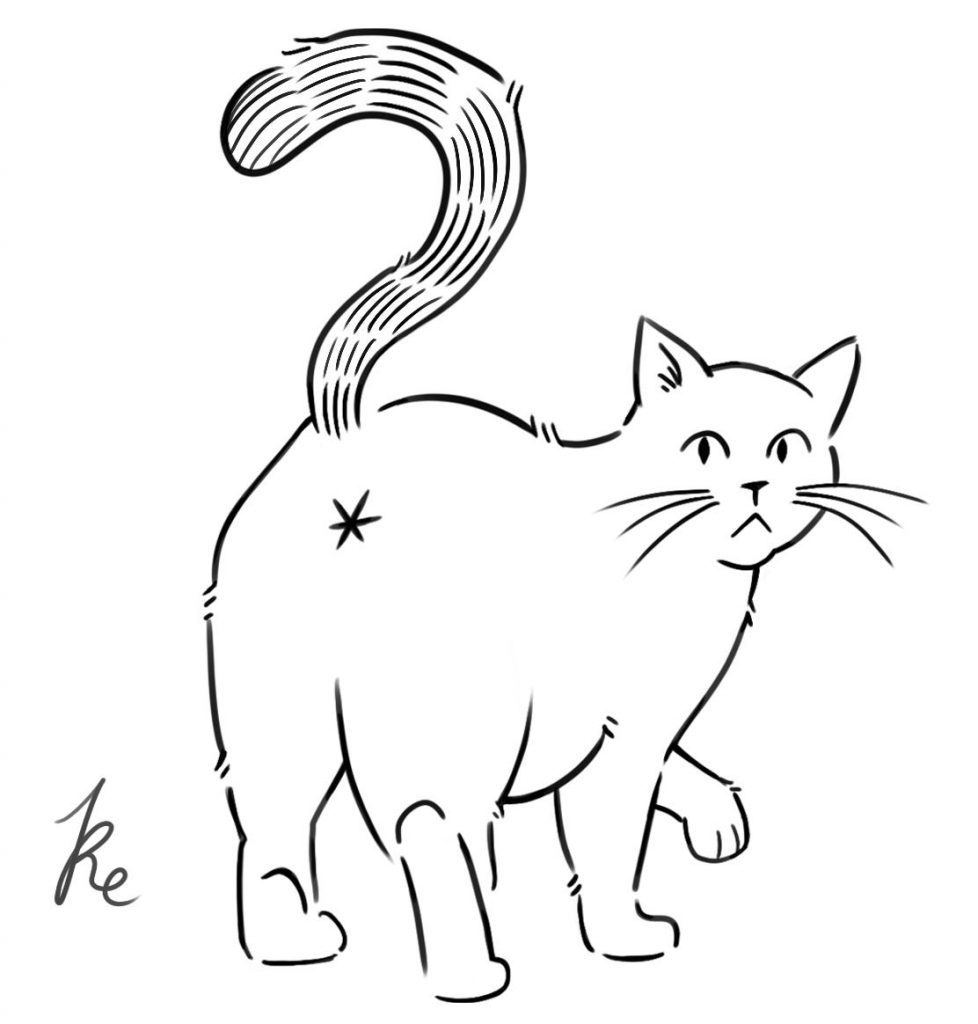
We all know that curiosity killed the cat. Allegedly, at least. But it wasn’t always exactly that way. As veteran researcher of English proverbs Gary Martin tells us in this article, before it became “curiosity killed the cat,” the phrase actually originated as “care’ll kill a cat.” That’s how it first appeared in a play by the English playwright Ben Jonson in 1598. Even though the phrase was already aimed, as it is now, at meddling in other people’s business, in a way “care” is a beautiful predecessor to “curiosity”: to care too much about something, to be preoccupied by something. As for the transition from one to the other, Martin begins by reminding us of the kind of reputation curiosity had:
Curiosity hasn’t received a good press over the centuries. Saint Augustine wrote in Confessions, AD 397, that, in the aeons before creating heaven and earth, God “fashioned hell for the inquisitive”. John Clarke, in Paroemiologia, 1639, suggested that “He that pryeth into every cloud may be struck with a thunderbolt”. In Don Juan, Lord Byron called curiosity “that low vice”. That bad opinion, and the fact that cats are notoriously inquisitive, led to the source of their demise being changed from ‘care’ to ‘curiosity’.
The message is clear: being inquisitive, asking too many questions and poking around is a dangerous offense; caring too much is a punishable crime. And in a way, it does make some sense. Some argue that, even in an ancestral, primal context, curiosity could easily be seen as an evolutionary disadvantage: hearing something rustle in the bushes and wanting to find out what it is, could very well result in the end of your genetic line. When survival is at stake, curiosity is a luxury; the price is too high, and the risk is not worth it.
However, here and now, fortunately, I happen to be able to afford it. And thank goodness, because it’s one of my favorite things ever. I don’t know what I would do without it. I think it’s one of the most valuable things I have. I even believe it might be an existential need. I feel like my life improves every time I discover something new. I think the things that seem to stand between us and that which is different are actually very small, and I believe reaching out and moving them aside is one of the best things a person can do.
In a world where ignorance equals extinction, our own and others’, I want to make the case for childish curiosity, the kind that leads us to peek over the wall, press our ear to the door, our eye to the keyhole, the one that leads us to ask something new, to listen to a song in a different language, to hear a story from a faraway place, to question something we thought we knew, to stray off the beaten path to see things we wouldn’t have seen otherwise, to make the line of the horizon slightly longer. I want to make the case for curiosity as the beginning of the red thread, the spark that leads to discovery, excitement and empathy, the key into that constructive potential of ours, so easily forgotten in the shadow of its opposite, which we know so well.
Over the past few years I’ve discovered so many things that made me throw my hands in the air and ask, “How did no one ever tell me about this before?”. Sometimes they were beautiful things, sometimes fascinating, sometimes unspeakably tragic and necessary. So I thought I’d just come here and talk about things, just in case someone, like me, could use someone who tells them about it.
Many centuries have supported the famous accusation against curiosity, against caring too much, and its dire consequences for the feline. Little is said, however, about the addition of a second half to that phrase, which first appeared in the early 20th century, and which might have been missing all along:
“Curiosity killed the cat,
but satisfaction brought it back.”