
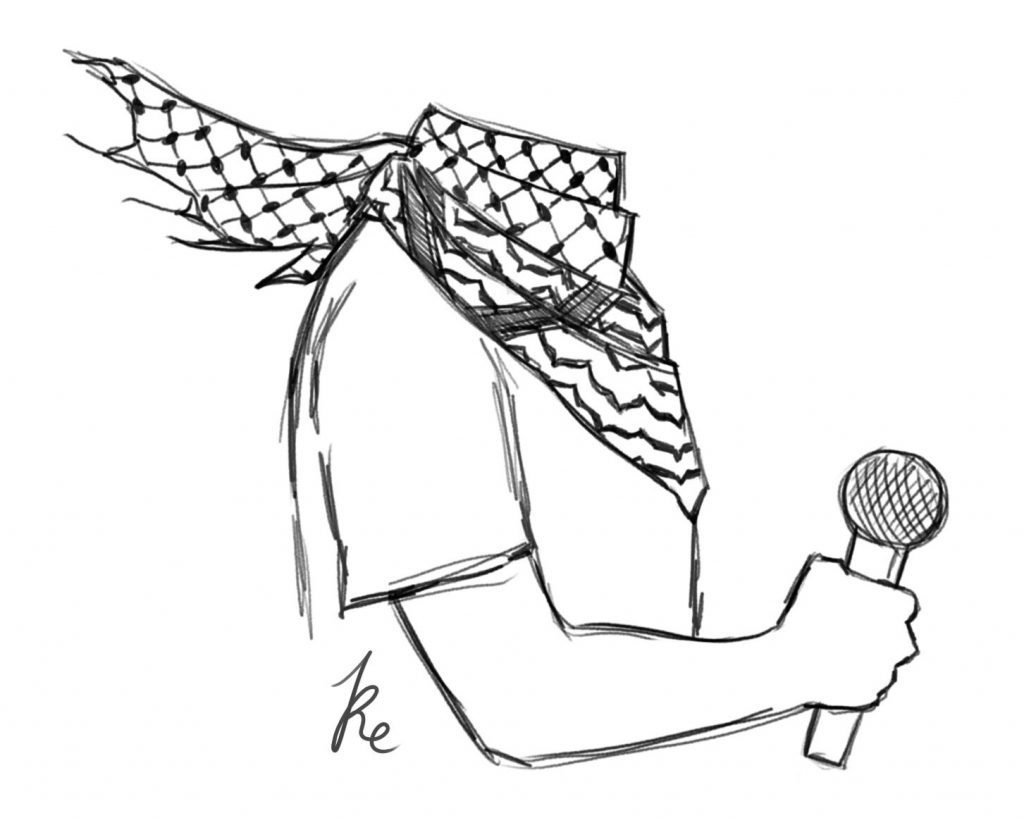
My journey began with an article on +972 Magazine by Palestinian rapper, actor, screenwriter and social activist Tamer Nafar, who I hadn’t heard of before. In it, he shared the raw, disillusioned vision of someone who questions what music and art can actually do in the midst of ongoing genocide. “I used to believe art could change the world,” he writes, “now it feels like an airplane black box: it won’t navigate the landing, it can only document the crash”. Later in the article, he proceeds to put together what he calls his “Black Box playlist”, which I highly encourage you to check out.
It was through this gripping article that I first discovered his song “Tuz Tuzzen”, “Whatever”. Through a tone of satire, underscored by a frankly catchy base, he talks about what he describes as “the helplessness that we Palestinian citizens of Israel feel as the state to which we pay taxes to massacres our people only a few kilometers away”.
He illustrates with some of his own lyrics:
To pay off your loan, take a loan, even two, whatever,
we leave this world with nothing.
Earn 100 bucks and the IRS bites off 200,
it bombs Gaza with 100 and the rest, you know where they shove it.
And here I am stuck in my head.
Sometimes I run away, sometimes I stay put.
Even if this hardship is more than I can take
I’m staying here, obstinate.
I’ll take a moment to say that the majority of videos linked throughout this article have English captions, remember to enable them when necessary!
This would be my first encounter with his talent, and it’s just one out of many examples. His social media is full of rap and activism, effortlessly ranging between dark satire and devastating truths.
We will circle back to this Nafar. But first, let’s go back a couple of decades.
In the late 90s, a 19 year old Tamer Nafar took his brother Suhell with him to a recording studio in their city of Lyd, southeast of Tel Aviv. There, Tamer enthusiastically went on the mic to record some rhymes for the first time. This would be the seeds of DAM, the first Palestinian hip hop crew and one of the first to rap in Arabic.
How do we know what that first recording session looked like? Well, it just so happens the brothers had a camera with them, and a few years later director and artist Jackie Reem Salloum would gather that video for her documentary “Slingshot Hip Hop”, one of my favorite discoveries to come out of my research for this article. Released in 2008, it’s an absolutely amazing piece of documentary cinema that follows the emergence of Palestinian hip hop under Israeli occupation, following various young rappers in their journeys through their restrained geographies, and showcasing the impact and relevance of rap as a tool of resistance and solidarity.
Nowadays, however, It’s also heartbreaking to watch, as we are reminded of what the situation was already like in Israel and Palestine in the 2000s, while knowing what it has become today. One can’t see the images of Gaza in the documentary without knowing that most of those buildings are most likely rubble by now.
As soon as I watched the trailer for the documentary, I went crazy trying to find it online. I was elated to find it available for streaming on the platform Cinelogue. I can’t recommend it enough.
“There was always something we loved about hip hop, but the music videos we saw only focused on the bling,” we are told by the voice of Suhell during the film, “but then, we saw a video by Tupac Shakur”, specifically the music video of “Holler If Ya Hear Me”, by deceased african-american rapper Tupac Shakur, known as 2pac.
“It looked like he filmed it in our hometown, Lyd”, says Suhell, “even though we didn’t know English and we didn’t get the lyrics, we made the connection”.
The mixed Arab-Jewish city of Lyd is well known for high rates of crime and a heavy presence of drug use and drug deals. To the Nafer brothers, even though they were continents away, their city was evoked in 2Pac’s video. Even though it was meant as a protest and revolution anthem about discrimination against black populations in the US, Tamer and Suhell would easily relate as Arabs in the state of Israel.
“We weren’t really political back then,” remembers a slightly older Tamer, “we didn’t really discuss politics, because it’s well known here that if you do, you screw yourself. I just wanted to be successful in music”.
This initial naiveté was not arbitrary. Both brothers were born citizens of the state of Israel, descendants of Palestinian families who stayed or ended up in what became Israel in 1948, as opposed to the over 700.000 who were massively displaced to neighboring countries, the West Bank and Gaza, which would come under Israeli military occupation and control after 1967. The brothers were part of what is known as “‘48 Palestinians”. As such, they were at least partly a product of Israeli society, initially disconnected from Palestinians in the occupied territories by the asphyxiating military restrictions and checkpoints of the region, which have been such a key element of the Palestinian experience for so long.
“We were young, confused,” says Suhell in the movie, “the occupation kept us mentally and physically separated from the Palestinians in the West Bank and Gaza”.
This initial dislodged mentality is even more clearly captured in the documentary “Channels of Rage”, where we see a young Tamer Nafar being, at first, an apparently enthusiastic friend and collaborator of the popular Israeli rapper Subliminal, yet visibly left out and increasingly confused when standing in the background, watching the Jewish crowds. The documentary tracks the splitting of their friendship as Subliminal becomes more fanatically pro-Israel, and Tamer more outspoken about the systemic injustice and discrimination experienced by Palestinians.
During both documentaries, we are shown plenty of examples of this experience. The Palestinian population is pushed into impoverished, dangerous neighborhoods, which, as opposed to the fancier Jewish districts, is clearly neglected by government, funding and police, leading to issues with crime, housing, healthcare, etc.; authorities commonly harass, search, detain and beat Palestinians who may very well just be walking around; merely speaking Arabic is a cause of alarm and suspicion for Jews and police; Abeer Zinati, a female Palestinian rapper who we will circle back to, was even fired from her job at McDonald’s for speaking Arabic (although she then went on to sue them and won); military checkpoints are set up and closed without warning, making it either very difficult or straight up impossible for Palestinians to cross from one area to another, sometimes resulting in them being locked in our out of their places of work or residence for days. One of the main points of “Slingshot Hip Hop” is whether or not the Palestinian rappers it follows, who live in different cities in the occupied territories, will be able to actually meet in person.
“The intifada, the uprising, was our reality check,” says Suhell in the film.
Marked by the image of Arab men, women and children throwing stones at the Israeli military and being met with assault rifles and tanks, the Palestinian uprisings of 2000 were a renewed reminder of the nature of Israeli repression and its habit of disproportionate response. The uprising was yet another burst of violent protest against decades of Israeli illegal occupation and segregation, and it would trigger a new cycle of violence between Palestinian armed and paramilitary groups, for which the Israeli military would further punish and target Palestinians as a whole.
So, “with a new third member, our neighbor Mahmood Jrere, we began a new chapter”. This would be the beginning of DAM as a crew. The name was an acronym for “Da Arab MCs” as well as the Arabic word for “everlasting”, and Hebrew for “blood”. As Tamer explained in an interview with Democracy Now! in 2008, “it’s eternal blood, like we will stay here forever”. It was also one of the first signs of the linguistic wit that would characterize their lyrics for years to come.
Their new chapter began in the year 2000, when they wrote their first openly political song: “Posheem Hapim me Peshaa” (“Innocent Criminals”), which would later be remixed by the Israeli rock musician Aviv Geffen in 2003, with American-Israeli director Udi Aloni making the music video, both of them openly against discrimination of Palestinians in Israel back then.
The lyrics looked like this:
You claim that we are equal,
I knock on your door for help,
surprise, surprise, you don’t even answer.
I live here, therefore there should be equality,
if it is a democracy how come I’m not mentioned in your anthem?
The land is for Jews and the Arabs don’t exist,
where is “shalom”? And when there is no “shalom”
a barrier is built to kill our dreams.
(In this section, the original Arabic uses the Hebrew word for peace which doubles as a common greeting, “shalom”).
The song obviously sparked controversy among Israeli audiences.
However, it would be their next song of protest, in 2001, that would prove to be their first real breakthrough, when a flared up DAM shot back at their society the question that would give the title to the track: “Min Irhabii”, “Who is the terrorist?”.
Similarly to “Innocent Criminals”, the lyrics didn’t hold back:
Democracy? I swear you’re Nazis,
with your countless rapings of the Arab soul
it got pregnant and birthed a boy called the suicide bomber,
and here you are calling us terrorists.
You hit me and then wept, you beat me to complaining,
when I reminded you that you started it, you sprang up and said:
”You let the little kids throw stones,
don’t they have a family to keep them under lock at home?”
What? You must have forgotten that you buried our parents under the rubble of our homes.
In “Channels of Rage”, Tamer Nafar, sitting in his dressing room in front of an almost comically shocked Israeli reporter, responds to her question about the meaning of the song: “What’s the difference between an Arab terrorist that blows himself up among twenty children, and a soldier that goes in and shoots them? I don’t think there’s any difference”. He goes on to exemplify: “if you dress up a cannibal in a tuxedo and give him a spoon and fork, he’s still a cannibal. Just because a soldier wears a uniform doesn’t make him a non-terrorist”.
The song was downloaded over a million times, and it remains one of the crew’s most popular and controversial songs, shining a raw light on the nature of discrimination against Arabs, and the perpetual cycles of violence and terror they’re so often held accountable for.
Throughout the years, the group would go on performing and participating in different collaborations and projects, usually connected to solidarity with the Palestinian populations in Israeli and occupied territories.
In “Slingshot Hip Hop”, we watch as Tamer visits the youth center “Camp Return”, where he was brought “to talk to the kids about rap, and how they can help their society and country with music, not violence”. DAM would be involved in plenty such activities in schools and clubs for Palestinian children and teens.
In 2004 DAM was invited by the Israeli NGO “Shatil” to take part in a campaign against discrimination and poverty in mixed Arab-Jewish cities, as described in the documentary and in this article by PBS. One of the main focuses was the common demolitions of Palestinian homes by the Israeli government, supposedly due to a lack of the necessary “building permits”, which of course had to be requested to Israeli authorities, and were often obstructed or dismissed. More specifically, the campaign wanted to raise awareness about the dangerous entrance into Lyd, which required residents to cross eight train tracks in order to get into the city.
DAM created a song and music video for the campaign, releasing versions in both Arabic and Hebrew, in order to reach a wider Israeli audience. The title translates to “Born Here”, and due to the success of the campaign, the Israeli government built a bridge above the train tracks for safer entrance and allowed DAM to tour through Israel discussing the importance of their cause.
Also significantly, the song and video featured DAM’s first collaboration with a female rapper, Abeer Zinati, AKA Sabreena Da Witch, one of the first female rappers in the region. She sings the chorus of the song, with DAM singing in between her lines:
Our neighborhood is embarrassed
not dressed in a silk dress
(if the fear will continue to live in our hearts).
A bride without a veil
standing, waiting, longing for her beauty
(ethnic cleansing knocks on our doors).
The time has passed over her, forgotten her
(that is why) the separation wall has muted her hope,
like a bird that will break out of the cage
she will spread out her wings and fly
(we will shout without fear).
In “Slingshot Hip Hop”, Tamer expresses his view of how “today, Arabs face the most discrimination. Palestinians even more. Plus the difficulties in our own society. And who gets it the worst? A woman, an Arab woman. It doesn’t get harder than that”.
In the movie, these statements appear alongside female rap duo Arapeyat, comprised by Safaa and Nahwa, who, according to the documentary, asked another one of the featured rappers, Mahmoud Shalabi, for some beats. “It was great to see young women rapping” he says, “so we invited Arapeyat to perform at a show with us and DAM”.
The documentary features a collaboration between Tamer and Safaa, where she sings:
You ask why do I cry?
Because I’m a body without a spirit,
you abuse it and then blame me.
Who the hell are you to tell me how to behave?
Asking me “where are you going?”
Hm, you seem to forget where you came from.
“We thought the guys can’t represent us and our problems and what we go through, so why not rap ourselves?” says Safaa in the film, “I was very lucky that my family helped me and supported me”.
“Slingshot Hip Hop” features some wonderful footage of the female rappers and their families, as well as audiences, young and old, male and female, enthusiastically enjoying their performances.
Unfortunately, it wasn’t as easy for Abeer Zinati, who, after appearing in the “Born Here” video and being scheduled to perform alongside DAM on stage and on TV, received threats from parts of her family. The ultimate fear would have been one of the infamous “honour killings”, which take place in the more conservative Arab societies, where members of a family or community would target and even kill one of their own, usually a woman, who would have supposedly brought shame on the rest.
Abeer’s parents, not really supportive of her music in the first place, thought it was too dangerous for her to perform. She was forced to agree and cancelled her appearance on the upcoming show. After that, she would go on making music in secret, and performing away from the areas where people could recognize her. It’s a sad reality in contrast with the support Safaa received from her own family when beginning to rap, even if other parts of their society tried to stop them. But the resilience of all of them is the same: “even if someone gets in our way, we will keep going. We won’t stop for anyone”, says Nahwa, mirroring Abeer’s drive.
Abeer eventually left Israel and moved to the US. Interestingly, during a Q&A after the screening of “Slingshot Hip Hop” in the US in 2009, when asked about how her experience changed as a woman doing music from Arab to American society, she responded very matter-of-factly: “I always had a lot of anger towards my society for not being able to do things as a woman, thinking that the men in my society are backwards and idiots, but apparently it’s a universal thing. Wherever I go there’s going to be men standing on my way saying ‘stop being a victim, we don’t want to hear you complaining’”. She says the main difference is that “here nobody knows me” and therefore “I don’t represent anyone here”.
This might raise the question of whether Abeer was underplaying the seriousness of the threats she had faced back home, and if her family specifically would have actually carried out such threats.
However, she goes on to say that, when it comes to the music, “it’s the same again, it’s the industry, it’s very sexist, and if I’m not half naked, they don’t really want to hear what I’m talking about”. She finishes with a casually bold statement: “I don’t feel much difference between here and there, I’m actually finding out that the US and Israel are twin sisters”.
In a similar vein, in an interview with PBS in 2015, Tamer Nafar would say that “women’s struggle is beyond the Middle East. It’s an international struggle”.
Female participation would become a critical part of DAM as a modern, progressive hip hop crew. Their first full album “Ihda” (“Dedication”), although mostly focused around the Palestinian struggle, included the song “Freedom for my Sisters”, an openly feminist song featuring Safaa from Arapeyat.
But it wouldn’t be until 2014 when DAM would finally feature a fourth, female member holding a prominent role throughout one of their most acclaimed albums.
Before reaching that point, DAM kept on cultivating various successes, getting several hit songs on the Arab charts, touring internationally, and then releasing their second album, “Dabke on the Moon”, in 2012. In an interview with The Electronic Intifada, Tamer spoke about how “during these six years, we’ve been all over the world. We’ve been exposed to a lot of cultures, we’ve been exposed to a lot of people with different stories. So suddenly, the world is not Palestine. Palestine became part of the world. And the struggle became part of the international struggle.”
The album would continue their political messages, initially trapped in their tragic realities, but slowly becoming more and more dance-friendly and optimistic under the influence of the Arab Spring. Tamer explains that, in the analogy made in the song where the Arab people are in a spaceship almost ready to take flight, “the Arab Spring taught us that to do so, we have to drop some of the weight. And we do, we open the window, and we throw out all the Arab leaders, all the dictatorships, all the corrupted money, and we are ready to fly”.
In 2014, DAM’s fourth member would finally make her appearance. Maysa Daw would be a key component of Dam’s outspoken criticism and protest of conservative values.
Maysa is originally from Haifa, another one of the Arab-Jewish mixed cities in the country. As she herself explained in a TEDX talk, she always knew she loved music, and she proceeded to pursue it with the support of her family, for which she expressed great gratitude. She grew up listening to all of DAM’s work, learning the lyrics, catching their live performances, and wondering if she could ever perform at that level.
According to Paper Magazine, their meeting came through the musical duo “Ministry of Dub-Key”, whose signature style combined reggae music with Palestinian folklore and dance, and who collaborated on a song with DAM members as well as with Maysa.
After that collaboration, the hip hop crew asked her to start writing and performing with them. Even though she didn’t consider herself a rapper, together they would have no trouble working out a new distinct style ranging between more spoken and more melodic rap, thus starting another chapter of DAM, quickly putting the spotlight back on feminist issues.
Maysa’s first song with the crew, “Who You Are”, came in 2014. The song opens with Maysa’s chorus:
I am the single, the sterile, and the divorced. I am the “better living with a man than living alone.”
I am the dishes, the ironing, I am everything, I am nothing, but remind me; who are you?
I am the women gossip; I can’t give birth to boys; I am the strong; I am 100 men.
I am the honor, I am the shame, I am the everything, I am nothing, but remind me; who are you?
As the group told PBS, through her lyrics Maysa acknowledges the comments and the gender norms that women endure daily, then hits back and confronts men and society, saying “Okay, I know who you THINK I am, but who are you, other than a judge?”. Like she told +972 Magazine, “men try to stereotype women all the time, and I just want to ask which stereotypes define men, if any?”.
The video was directed by Scandar Qupti, who also directed the award-winning film “Ajami”. The result is a true exercise of simple yet wonderfully quirky visual creativity, and should not be missed.
In 2017, DAM signed a new record deal and started working on the crew’s third album, “Ben Haana Wa Maana” (“Who really benefits?”). It was publicly released in June 2019, featuring Maysa as the main face of the album.
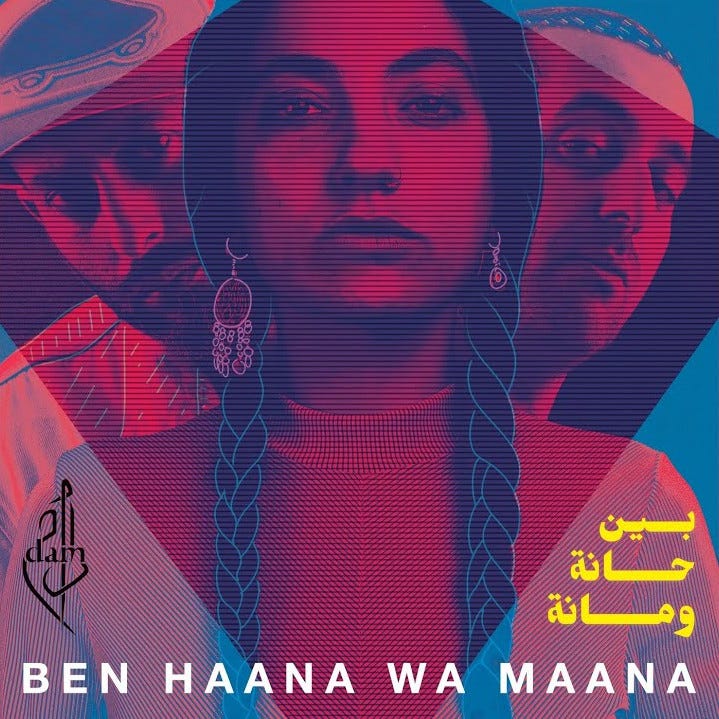
During an interview with Sole DXB, Maysa expressed how “being the face of the album by itself is very weird for me, we had a whole discussion about it actually, and it was Tamer’s idea. He said ‘you need to be there’”.
She would have her most prominent role in the track “Jasadik-hom” (“Your Body of Theirs”), a head-on, incredibly powerful feminist manifesto, starring a no-nonsense Maysa talking directly to the audience:
Don’t you stare, these breasts are mine,
take your hands off, these hips are mine,
spare me your comments, this arm hair and armpit hair are only mine,
control your facial expressions, these few extra kilos are mine,
the cellulite is mine, these stretch marks and birth giving marks are only mine,
the grey hair, warts, freckles, thighs, the pimples, all of them are mine,
this kitchen is not only mine, but this thyme and gundelia are mine,
my skin tone is mine, and these eyes are mine.
Both her lyrics and her delivery make it an absolute must watch.
The album obviously contained its fair share of other political material. For instance, their song “Milliardat” (“Billions”) criticizes occupation, censorship and lack of funding for Palestinian artists and overall communities in Israel and calls for the renovation of its values. It begins with a great jab and flex:
Billions are spent to keep us separated.
Our song “Who’s the terrorist” has only cost a few pennies
and they sing it in Lyd, Damascus and Ein Al Hilwe.
And later:
No prophet is respected among his own people,
if you want to resist, you’ll be sentenced,
you’ll be welcomed with tomatoes, not a Grammy.
The crew’s political intentions seemed as clear and sharp as ever. However, this new album was marked by more than the group’s well known and expected protest style. Continuing on the path already suggested in “Dabke on the Moon”, the group says on their website that “we always talked about the darkness we live in. But this time we changed our attitude. As we say in one of our songs ‘Hada Yidi’e Sitna’; this is not a darkness of a tomb, we are in a darkness of a womb”. They say the album itself is ultimately “about self-love”.
Actually, their first single off the album, “Emta Njawzak Yamma”(“When will you get married?”) is a fun, dancey and even commercial song about the social pressures of marriage and getting one’s life together. All in all, surprisingly harmless content for an audience used to anti-occupation protest anthems, and with a fun music video to go with it.
In their interview with Sole DXB, Tamer explains how “when we did that a lot of people texted me ‘but what about the cause, what about Palestine?’”. Even Maysa admitted to having trouble accepting this kind of sound and vibe at first, used as she was to their more underground hip hop style. In the interview, Tamer says “I do have an issue with occupation, so I write about that, and I do have an issue with women’s rights, so I write about that… but in between I do have fun, I get drunk, I party, I go to weddings. So, for me, this is keeping it real”. He wonders about the legitimacy of making the occupation his only drive as an artist, asking “if the occupation ends, does that mean Palestinian hip hop is no longer relevant?”, and “Am I only a geographical talent?”.
Maysa agrees, saying that “yes, we have a lot of difficulties, and yes, we have a lot of things that we need to say, but at the same time it’s really important to be true, to look at ourselves as humans and the whole spectrum of what being human is”.
The question of what comes first, art or identity, has naturally been very common throughout their careers. In her TEDx talk from 2021, and perhaps projecting some of her own doubts at being made the face of DAM’s third album, Maysa would talk about “how difficult and frustrating it is for me to be constantly identified as a Palestinian woman artist, rather than just an artist”. In the end of her speech, she concludes by embracing those parts of her identity in the face of the bigger issues at hand.
Tamer also speaks about being perceived as a Palestinian first. During his interview with Ahmed Eldin, he says “every time I stand on stage I’m like ‘we are artists before everything’. If you close your eyes and forget we are form Palestine, and you go into the lyrics and the punchlines, you see how brilliant it is and how creative it is”.
Still, “Ben Haana Wa Maana” contains plenty of songs which are both political and creative, exploring topics of identity, society, occupation, and more. I highly recommend not only listening to it, but also looking up the lyrics, as much as with their previous two albums, because there’s so much of it that’s brilliant and worth quoting.
After their 2019 album, DAM kept on touring and performing around the world. In the meantime, Maysa Daw had also kept on working on her own projects, such as her first solo album “Between City Walls” which was already released back in 2017, and her subsequent work with Palestinian-Swiss-Dominican band “Kallemi”, where she sings and plays several instruments.
Tamer Nafar also continued to be a prolific solo rapper, as well as a screenwriter and actor. By the time DAM’s third album was out, he had already written and starred in his semi-autobiographical movie “Junction 48”, released in 2016, for which he also collaborated with Maysa for the soundtrack.
He swung back to political tracks and music videos about Palestine on his solo works. Before the renewed escalation of violence between Palestinians and Israelis in May of 2021, Tamer was already planning to create a powerful collaboration with the then 12-year old rapper from Gaza MC Abdul, also featuring vocals by Palestinian singer Noel Kharman.
The result is an amazing piece of media of protest, resistance and unity, featuring two Palestinian artists using the wall that separates them to bring them together in the music video.
Another example is the track “Ebn al Lyd” from 2022, a song about Tamer’s hometown. For the music video, he drove around his neighborhood on a bike with a Palestinian flag late at night, in response to a proposed law that would make it illegal to show the flag in certain places. As shown in his “Backstage” video, during recording he was stopped 3 to 4 times by police in the space of the first hour. Meanwhile, Tamer’s team saw and recorded one of the so frequent drug deals taking place in one of the streets, with no police in sight.
Tamer kept on writing, singing, collaborating and advocating as prolifically as ever. Then, the final months of 2023 arrived.
During the attacks on October the 7th of 2023, Hamas and other militant Palestinian groups killed over 1,100 Israelis, left over 4,000 wounded, and took the infamous 200 hostages.
By December of that same year, the Israeli military had already killed over 20,000 Palestinians in Gaza. Today, it’s well over 60,000. More and more international organizations have clearly categorized it as genocide over the course of the year, and are investigating Israel’s actions in Gaza as war crimes and human rights violations.

During his interview with journalist Ahmed Eldin, Tamer says “when we were kids and we started doing hip hop back in ‘99, we were like ‘Yeah, we’re gonna go on stages and tell the truth about Palestine!’, because back in the Nakba (in 1948) there wasn’t cameras. So people didn’t know”. Today, there are plenty of cameras. The footage is endless, and we all know. “It’s insane how the world is moving on”, he says.
We finally circle back to the Tamer Nafar that would record his song “Whatever”. Once again, during the interview, he talks about one of the things that led to what he calls “the day I realized I’m a sheep”. He explains: “I perform, I make money, they (Israel) take 30% or 40%. The money is not being invested back in my community. Where does it go? It goes to Gaza”. At some point, he concluded that “you literally see that even if you want to or not, fuck you, you’re gonna be part of a system bigger than you. It’s really sad, but that’s facing the facts”.
He describes an even more impactful episode, which lead to one of his neighbors being murdered by Israeli settlers, a way too common occurrence in rural areas of the West Bank, which this time happened right next door to Tamer. “This is where my ideology started fading”, he said.
He describes the day saying a curfew was announced, and Arabs were made to go back into their homes. “Suddenly you hear screams, ‘death to the Arabs, death to the Arabs’. Tons of settlers, mostly from outside of Lyd, with short Uzis, around our neighbourhoods, screaming ‘death to the Arabs’, and they are escorted by the cops”. Still, he called the police, mostly to record the interaction, and was quickly and predictably dismissed, saying that they knew about the situation. “I know you know, you are guarding them,” Tamer replied, “you are guarding armed people against unarmed people”. In fact, Palestinians stopped being ellegible for a weapons license after the attacks of October 7th, while the arming of civilian Jews was extensively facilitated. That was when he realized, “most of my neighbors are scared, except for the drug dealers, who have guns”.
He makes a discouraging analogy, as if the ideology and art built over the course of his career was this seemingly powerful tool kept under a “break in case of emergency” glass. “You have it there for 20 years, 30 years, and suddenly, when the emergency happens, you go grab it and realize ‘oh, fuck, it’s just plastic’”. Although he makes it sound comical, he described that night when Israeli settlers came to his neighborhood as a huge psychological blow: “suddenly you realize you feel good that you have a drug dealer in your neighborhood, because he might protect you. Not the police, not your microphone”.
It’s necessary to understand why this moment would have been so shattering. Ever since their beginnings, one of the biggest problems the young Nafar brothers grew up with, resented and denounced in their city was drug use and drug dealers. It was one of the most destructive and prevalent ailments of their community, as well as one of the most evident signs of the wilful ignorance of the Israeli government, who clearly invested in the richer, more resourceful Jewish neighborhoods over the Arab ones, and whose police were less concerned about busting drug deals than they were about harassing Palestinian citizens. In “Slingshot Hip Hop”, during one of DAM’s visit to one of the youth clubs for Palestinian children and teens, Abeer Zinati says “children used to look up to drug dealers, maybe because they have money and cars. DAM came and changed that. They are now the role models that kids look up to”.
With all this in mind, we can begin to grasp Tamer’s sincerity when he described the settler episode, and the moment in which he found himself being thankful for the presence of a drug dealer in the neighborhood, as “a crisis of identity, of artistic identity. It was very hard for me as a human being”. He doubles down on his disappointment: “you put your life on something called values, and humanity, and using words that are like ‘white words’, like ‘democracy’… and suddenly you are 45 and you realize it’s all fake, it’s nothing. So what the fuck am I supposed to do now?”.
One of Tamer’s latest songs, released last August, is called “Today”.
I want a crane to carry me,
to drop me off at some shore,
me and the people who love me,
just to talk and walk,
on sand that doesn’t care about my weight,
under a sun that doesn’t know my name.
Shortly after he released “Oasis”, featuring Greek singer Alex Mandi. In it, he sings:
Let the planet fall apart, go to hell, I don’t care,
I want a quiet green spot, a green spot, a beautiful life,
clear our minds, pour up our drinks, with loved ones filling our heart.
And at the end of the bridge:
I’ve never been selfish,
I’ve never been materialistic,
I wanted to change the world, then woke up one day
and saw a different dude in the mirror.
One thing seems clear: Tamer Nafar is tired. For years, he wanted to protest, to fight, to speak out. Then, it seemed to become clear that speaking out meant little. The mass killings have become more, and his freedom has become less.
If he tried to record the music video for “Ebn al Lyd” today, after October 7th, riding around his neighborhood with a Palestinian flag, “best case scenario you could be arrested, worst case scenario you might get shot”. As for performances in Israel and Palestine, he “used to do about 100 shows a year. Since October 7th, I’ve done 2 shows. I perform elsewhere, but here, forget about it”.
He also realizes his position in the bigger scheme of things: “There’s a guy now in Gaza that’s like ‘look at this guy, doing podcasts because he has the time for it, and I don’t have electricity’. Yeah, I can understand that”.
Still, his overall spirit evokes the inescapability of some of DAM’s old verses, like in “Who is the terrorist?”, when they sang:
I’m not against peace, peace is against me.
Or, in “Born Here”:
I broke the law? No, the law broke me.
When asked about how he copes with the grief and the day to day news about the ongoing massacre in Gaza, his answer is simple: “you just go to therapy, habibi”.
As to the everlasting question of the art versus the artist, he has changed his mind. After October 7th, and “after years of battling it” he says “I think I’m now a Palestinian before an artist, because my art is not in danger as much as my identity as a Palestinian”. He says that “my feeling now is that the most vulnerable thing is our body, the physical one, not the ideology, I feel threatened on my body”.
In an almost meta statement, he wraps up the question: “I need to free Palestine, in order to be freed of Palestine”.
Still, this statement comes along with what he describes as a flourishing of his creativity, “tripling by the day”, thanks to what he characterizes as the realization of his own limitations, of what he can and can’t do. Indeed, his creativity seems to be very much his own.
He says his main drive and his only focus now is his work. He has new music coming up, his first EP in english, which he will call “In The Name Of The Father, The Imam & John Lennon”. When asked about what he’d like to rap about in the future, he responds “I’d love to make an album about relationships”, and also admits having had some such songs ready, but delayed them because “it was not the time for it”.
What he currently enjoys the most is writing. For the last 2 to 3 years he’s been mostly writing articles and op-eds, which he finds way more freeing than writing lyrics. He has also signed with an American publisher to write and publish two novels in the coming years.
“This is what is keeping me sane, writing. This is my new therapy. This is the tool that I’m using. Because, as I said, that’s what I know. I wish I knew something else. I wish my talent was to break the siege and give food to people. I fucking wish”.